From Perception to Practice: Understanding Omani Undergraduate Journeys in Academic Research
DOI:
https://doi.org/10.47259/ijrebs.2025.625Keywords:
Dissertation challenge, Critical thinking, Adult education, Continuous education, Academic researchAbstract
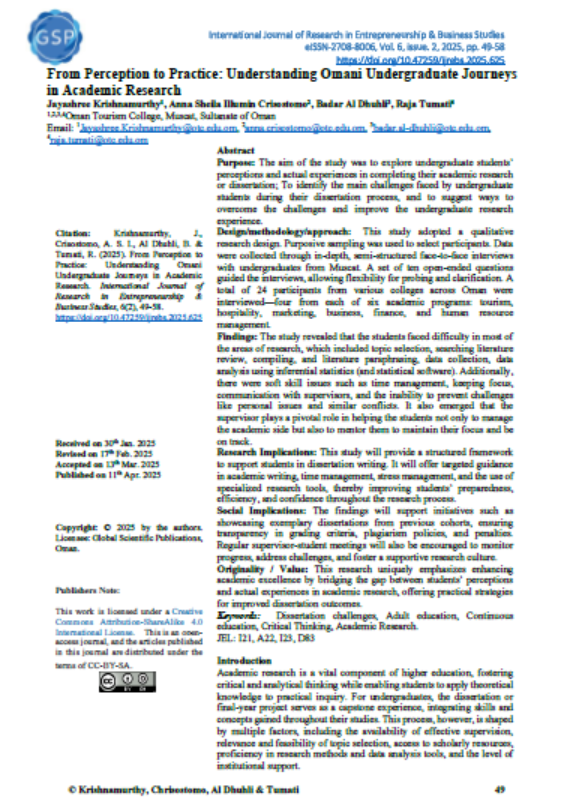
Purpose: The aim of the study was to explore undergraduate students’ perceptions and actual experiences in completing their academic research or dissertation; To identify the main challenges faced by undergraduate students during their dissertation process, and to suggest ways to overcome the challenges and improve the undergraduate research experience.
Design/methodology/approach: This study adopted a qualitative research design. Purposive sampling was used to select participants. Data were collected through in-depth, semi-structured face-to-face interviews with undergraduates from Muscat. A set of ten open-ended questions guided the interviews, allowing flexibility for probing and clarification. A total of 24 participants from various colleges across Oman were interviewed—four from each of six academic programs: tourism, hospitality, marketing, business, finance, and human resource management.
Findings: The study revealed that the students faced difficulty in most of the areas of research, which included topic selection, searching literature review, compiling, and literature paraphrasing, data collection, data analysis using inferential statistics (and statistical software). Additionally, there were soft skill issues such as time management, keeping focus, communication with supervisors, and the inability to prevent challenges like personal issues and similar conflicts. It also emerged that the supervisor plays a pivotal role in helping the students not only to manage the academic side but also to mentor them to maintain their focus and be on track.
Research Implications: This study will provide a structured framework to support students in dissertation writing. It will offer targeted guidance in academic writing, time management, stress management, and the use of specialized research tools, thereby improving students’ preparedness, efficiency, and confidence throughout the research process.
Social Implications: The findings will support initiatives such as showcasing exemplary dissertations from previous cohorts, ensuring transparency in grading criteria, plagiarism policies, and penalties. Regular supervisor-student meetings will also be encouraged to monitor progress, address challenges, and foster a supportive research culture.
Originality / Value: This research uniquely emphasizes enhancing academic excellence by bridging the gap between students’ perceptions and actual experiences in academic research, offering practical strategies for improved dissertation outcomes.
Downloads
Published
How to Cite
Issue
Section
License
Copyright (c) 2025 Jayashree Krishnamurthy, Anna Sheila Illumin Crisostomo , Bader Al Dhuhli, Raja Tumati

This work is licensed under a Creative Commons Attribution-ShareAlike 4.0 International License.